Can acne patches be sterilised?
- Share
- Issue Time
- Nov 28,2026
Short answer: yes, a hydrocolloid or microneedle patch can be sterilised — but "sterilised" and "sterile" are not the same thing, and only the second one may be claimed on a pack. The gap between them is a validated process, a sterile barrier system and a stack of documentation. Most cosmetic patch ranges never need to cross that gap.
Two different questions hide behind the word
When a brand asks whether we can sterilise, one of two things is usually meant.
The first is a hygiene requirement: the product is manufactured under controlled conditions, bioburden is monitored, and it is not expected to be microbiologically clean at the level of a medical device. This is what a cosmetic hydrocolloid patch is. It is made under an ISO 13485 quality system, filled in a controlled area, and released against bioburden specifications rather than against a sterility assurance level.
The second is a sterility requirement: the product carries a claim of sterile, which in practice means a validated process has demonstrated a sterility assurance level of 10-6 — a probability of one viable microorganism per million units — and the pack is a validated sterile barrier system that keeps that state until the user opens it.
Both are legitimate. They cost very different amounts, and they are audited very differently.
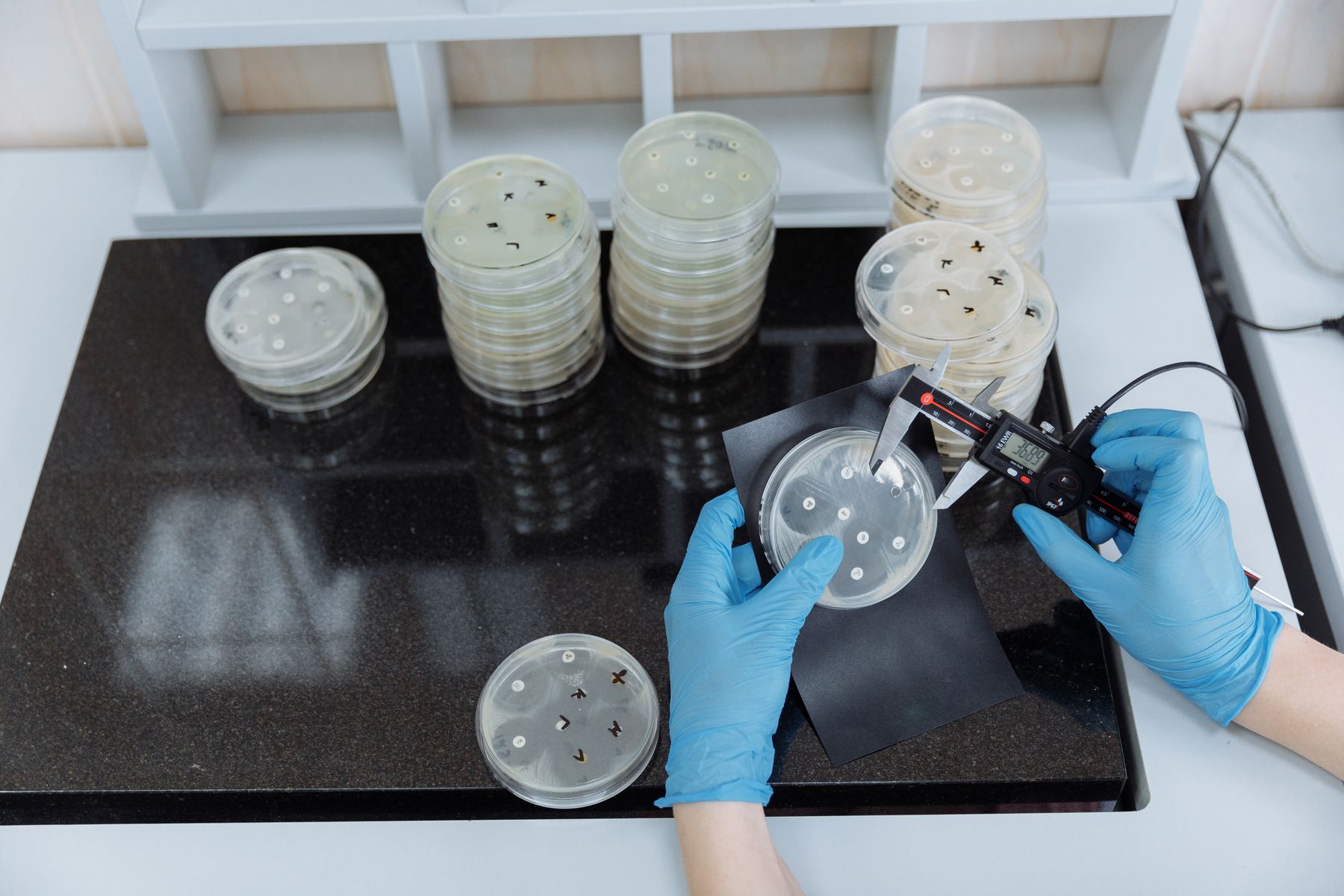
Bioburden is measured, not assumed: counts from a defined sample, per ISO 11737-1, set the baseline that any sterilisation validation has to be built on.
What a sterilisation cycle does to a patch
A hydrocolloid patch is a stack of heat- and moisture-sensitive materials: a hydrocolloid matrix, an adhesive layer, a polyurethane or PE backing, and a release liner. Every sterilisation method interacts with that stack differently, and the interaction is not only microbiological — it is physical.
| Method | Typical cycle | Effect on a patch | Where it fits |
|---|---|---|---|
| Ethylene oxide (ISO 11135) | Conditioning, gas exposure at roughly 38–60 °C, then aeration to drive off residuals | Gentle on adhesives at the temperatures used, but the gas penetrates through packaging and must be aerated; residuals are assessed against ISO 10993-7 | Common route for wound-care and device-adjacent patches in foil or Tyvek-style pouches |
| Gamma irradiation (ISO 11137) | Typically 25–40 kGy, dose set by validation | Can cross-link or yellow the adhesive and backing, and tack often drops; colour matching needs re-qualifying after the cycle | Large volumes, where the cost per unit is low and the material can take the dose |
| E-beam | Similar dose range, delivered in seconds rather than hours | Shorter exposure limits oxidative damage, but penetration is limited, so pack geometry and density matter | Thin, low-density packs and shorter lead times |
| Moist heat (autoclave) | Around 121 °C saturated steam | Hydrocolloid matrix softens and the pouch seal is stressed; generally not compatible with this product family | Rarely applicable to hydrocolloid patches |
The practical consequence is that the method has to be chosen against the material, not against the calendar. A range that starts with gamma because a supplier already runs it may end up re-qualifying the adhesive and the printed colour; a range that starts with EO pays for aeration time instead.
The paperwork a sterile claim triggers
Sterility is not a test performed on the finished batch and signed off. It is a validated state that has to be demonstrated continuously. In practice that means:
- Bioburden monitoring on the product before sterilisation (ISO 11737-1), with a defined sampling plan rather than an occasional check.
- Validation of the sterilisation process against the chosen standard — ISO 11135 for EO, ISO 11137 for radiation — including a dose or cycle established by validation, not by default.
- Sterility testing or dose audit (ISO 11737-2) at the interval the validation defines, which continues for the life of the product.
- A sterile barrier system validated to ISO 11607: seal strength, integrity, ageing and transport, because a sterile product in a pack that fails at the seam is not sterile at the point of use.
- Residuals and biocompatibility where the method leaves them — EO residuals being the usual case.
What this costs in time: expect a sterilisation validation to add weeks rather than days to a first run, and to require a fixed material and pack construction for the duration of the validation. Changing the adhesive, the backing or the pouch after validation usually means repeating it.
The classification question comes before the process question
This is where most projects get the order wrong. A sterile claim is rarely a labelling decision on its own — it usually travels with a use claim.
If the product is presented for use on intact skin to cover a blemish, it sits in cosmetics, and a sterile claim is unusual and hard to justify commercially. If it is presented for use on broken skin, on a wound, or after a clinical procedure, then the combination of a sterile claim and that intended use generally moves the product into medical device rules — in the EU under the MDR, in the US under device requirements, with the classification and the route depending on the intended use and the duration of contact.
That shift changes far more than the label: it brings a conformity route, technical documentation, clinical evaluation or an equivalent evidence path, and post-market obligations. It is worth settling before a sterilisation vendor is contacted, because the classification decides whether the validation is even the right conversation.
What can and cannot go on the pack
- Usable, if true and supported: "sterile" — only with a validated process, a stated SAL and a validated sterile barrier system, and only where the classification allows the claim.
- Usable, if true and supported: "manufactured under ISO 13485" or "produced in a controlled environment" — describing the system, not the microbiological state of the unit.
- Not usable without a different regime: "antibacterial", "kills bacteria", "sterilises the skin" — these are biocidal or therapeutic claims, not descriptions of a manufacturing process, and they attach a different set of rules entirely.
- Not usable at all: "sterile" as a marketing adjective on a product that has only been made hygienically. It is the fastest way to turn a labelling question into an enforcement question.
For a cosmetic range the defensible position is usually the honest one: state that the product is manufactured under an ISO 13485 quality system, keep bioburden controlled, and leave the word sterile off the pack unless the device route is genuinely intended.
Deciding whether your range needs a sterile claim?
We manufacture hydrocolloid patches, custom shaped patches and dissolving microneedle patches under ISO 13485 (certificate 69136). Tell us the intended use and the market, and we will say plainly which route applies and what the pack can carry.
This article describes common practice and is not regulatory advice. Sterilisation method, validation and classification should be confirmed with a notified body or regulatory consultant for the intended use and market.